
Street Fighter IV (DirectX 9).
Despite being a DirectX 9 title, it does support multi-core processors. It’s also a very popular game that many of us grew up with. The latest version is definitely far more demanding with much improved graphics. Let’s see how well it uses the extra cores.
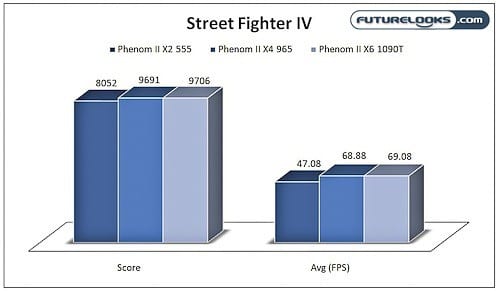
It certainly looks like Street Fighter IV does like a couple of extra cores and benefits are seen using the X4 over the X2. However, advantages of using the X6 over the X4 is definitely much smaller.
Resident Evil 5 (DirectX 10).
While we’re on a CAPCOM kick, Resident Evil 5 also supposedly takes advantage of multi-core CPUs. We run the DirectX 10 version of the benchmark to see if there are any benefits from going with extra cores of glory.
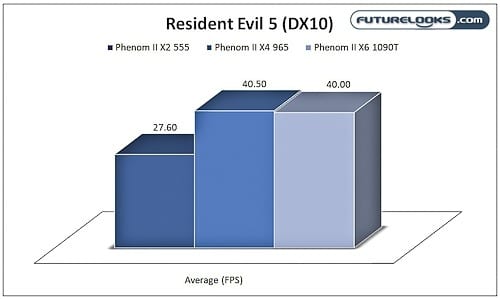
No glory for the X6 here. It’s pretty much neck and neck with the X4, but gets edged out ever so slightly by the faster CPU cores on the X4. There’s no hope for the X2 as it lags behind. There is definitely benefit for multiple cores to a certain extent.
Far Cry 2 (DirectX 10)
With a huge destructible world, Far Cry 2 should give our CPUs a good work out. I’m going to say that what we’ve been seeing so far with the four cores being the sweet spot will happen here.
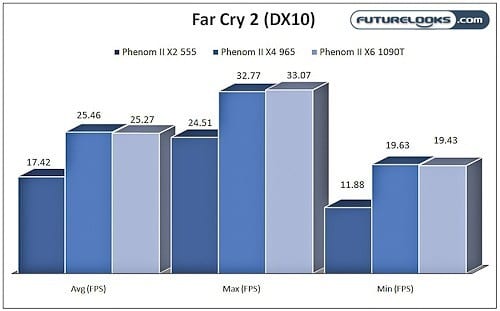
So it looks like we’re going to get the same results. Two cores aren’t so great, four cores are better, but six cores don’t seem to make a difference. It looks like a large number of titles are JUST starting to take advantage of four cores and it might be a while till we see titles optimized enough to show advantages with two more cores. Nonetheless, we soldier on.
HAWX (DirectX 10)
Our last game is the very pretty looking HAWX from Ubisoft. This game has elements of a Flight Simulator with huge maps and multiple bogies, missiles and other units that need a competent CPU to control, characteristic of an RTS. We’re hoping to see something from our extra cores in this test.
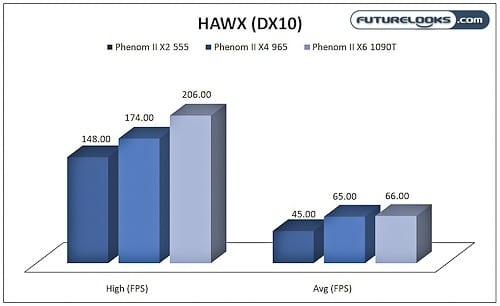
Although we get a good boost in the highest possible frame rates for the X6 by a mile, we don’t see more than a single frame difference in our average frame rates. However, we do see a significant difference between the X2 to the X4, but it would seem that extra cores above four does us no good here yet again.
Power Consumption and Temperatures
For the most part, games are a bust, but video rendering and other applications that provide heavy computational work loads relish in the presence of the Phenom II X6 1090T. However, if you’re a gamer that does make videos, rip music or do heavy graphics projects, having the extra cores might not be a bad idea, overall. The question is, will having the extra two cores suck anymore power? We took full system readings of our test system which each CPU to see what the impact on the socket is.
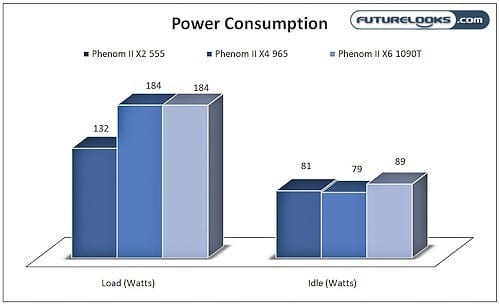
Well, it looks like there is a minor environmental impact when your system is idling with two extra cores, but no environmental impact to having the extra two cores under load. This is consistent with AMD’s design which places the TDP of both the X4 965 and X6 1090T at 125W. Despite the idle power hit, applications that take full advantage of the extra cores, like in the case of video rendering, will allow you to turn your system off faster after a hard days work, which saves you power. You’ll also save a ton of time too, waiting for your projects to finish processing.
As for temperatures, our X6 1090T idled at around 16.5 C and hit its ceiling at 34.5 C under load using our Thermaltake V1 CPU cooler. This is really decent and gives me hope that we can hit a decent overclock with little to no added voltage.