
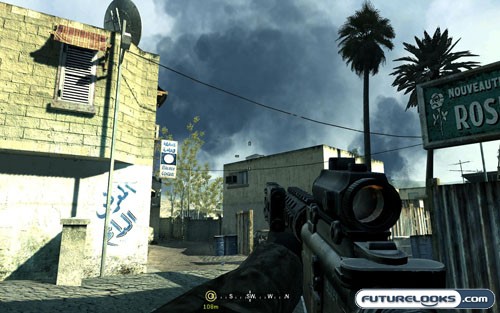
As for playability, the tactical play style of CoD4 is one environment where you don’t want any frame lag. With the results gleaned from out benchmarks, the last thing you need to worry about is dropping frame rates. Our benchmark was run using the opening mission where you attack the freighter, but playing the game through the next missions demonstrated that the frame rates didn’t go much lower than what our results show.
Crysis
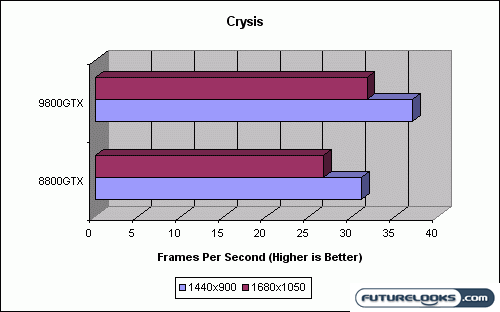
Now it’s time for the real back breaker. Crysis, like Call of Duty 4, was released in November 2007. Unlike CoD4, Crysis was a very punishing DirectX 10 title that brought many systems to their knees with it’s powerful 3D engine. Like it’s spiritual predecessor Far Cry, this game was built with the ability to display the most incredible open ended environments seen on a PC. For our testing purposes, we ran the built-in GPU timedemo using all high settings with no Antialiasing or Anisotropic filtering.
While not quite the tour de force of high frame rates that our last games were, the tests run in Crysis do note a marked improvement over our 8800 GTX comparison card. We didn’t exactly have enough headroom to start playing with Antialiasing and Anisotropic Filtering, but the details shown in high mode were more than worth it.
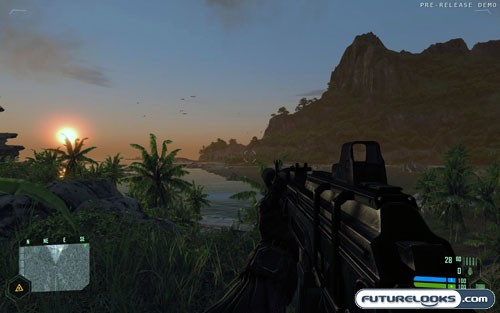
Now when you get a game that only averages just above the 30 frames per second threshold, you are inclined to think that there are a few parts where the game is nigh unplayable. After all, 30 frames per second is the minimum amount of frames you need before what you are viewing turns from smooth animation to a colourful slide show. Crysis did have its moments, and the lowest I saw was 20 frames per second during game play. Overall the gaming experience was ok, but Crysis is still a pig when run on high settings, and probably needs a multi-GPU platform like SLI to really tackle it.
Real-Time Price and Stock Check – Shop Like a PRO!