
Power Consumption
Looking at the power consumption of the entire system during operations, since the only variable here is the APU being used, it will be the only thing changing the power consumption. I have also corrected for my Antec 850W HCP efficiency to get the most accurate wattage regardless of PSU being used. The end result should give us an idea of the amount of power you should expect for your system.
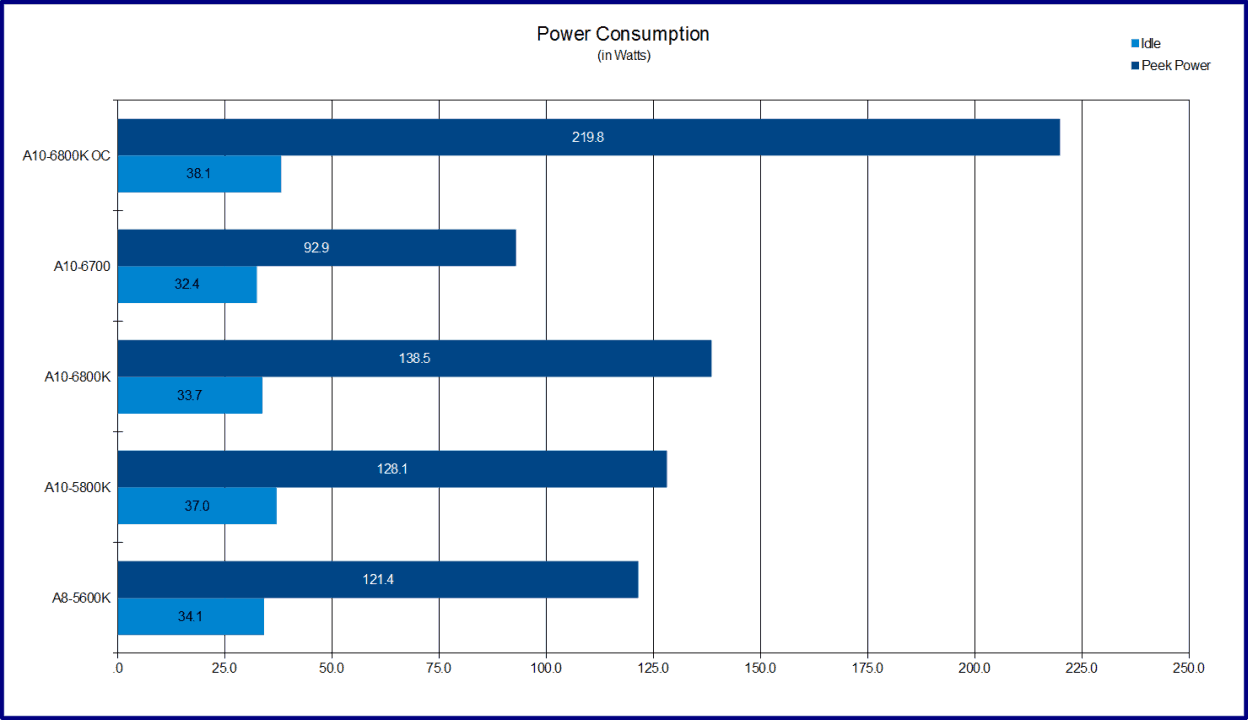
The two things that immediately jump out is when the A10-6800K is overclocked and the A10-6700 is at full load. The 6800K is no surprise when both the CPU and GPU sections overclocked, with no power management features enabled. However, it is the complete opposite story for the 6700 as it stays below 100W even at full load. Considering its overall performance this is quite impressive as it matches or out performs the A10-5800K while using 36 watts less power during full load.
The A10-6800K at stock clocks does use a little extra power at load, but comes in a few watts lower for idle to balance it out. Now that we have all the figures, we can finally summarize what the Richland APUs are all about.
Final Thoughts
We are glad to say that we are truly impressed with the new AMD A-Series Elite APUs for the most part. The new A10-6800K and A10-6700 show AMD can still get more performance out of the 32 nm silicon they are currently using. While this is good to see, AMD needs to move to a smaller manufacturing node soon to catch up with its prime competitor. I believe the A-Series Elite is just a stepping stone to their next big evolution with the APU design.
The AMD A-series Elite seems to be like the first APUs with AMD testing new grounds in the memory controller. It is clear they are working on improving throughput, latency, while offering better performance with higher clocked memory. If anything could benefit from better memory performance, it would be the A-series. Especially with rival Intel trying to catch up in the IGP department. This is one area AMD currently has no competition and they need to keep it that way.
Our only major issue is the use of new labels for an APU that is architecturally no different than its previous generation. For example, the FX series flagship CPU went from the FX-8150 to the FX-8350 and there were serious updates to the design with the new Piledriver architecture. The A-series Elite got an improved memory controller and high clock speeds, but gets re-branded as though they are an all new architectural design. While we can understand the marketing aspect, it doesn’t mean we have to like it.
The A10-6800K is priced at $149.99 US which is $20 higher than the A10-5800K parts still available on the market. But is it worth the extra money? Without a doubt it is. But not as a upgrade to an existing system. If you already have an A-series 5000 APU, then a dedicated graphics card would be a much better option for your money. The A10-6700, found at $148.99, is a much more attractive option due to its superior power management and lower TDP. Especially for a Small Form Factor build where both aspects are extremely important.
Directly compared to their predecessors, the new Richland 65W APUs should be the stand-outs for the A-series Elite and offer a lot of value for those building a new system on a budget today.
Pros:
- Flexible Overclocking
- Drop In Upgrade for the Virgo FM2 Platform
- Power Management Improvement for 65W chips
- Significant Graphical Performance Improvement
- AMD CrossfireX Support
- AMD AMP! Support
- AMD Turbo 3.0
Cons:
- A10-6700 Only – Limited Memory Speeds
- CPU Improvement mainly Clock speed related
Overall Score: 8.5 / 10.0

Help Us Improve Our Reviews By leaving a Comment Below!