
Driving the Hard Drive Really Hard
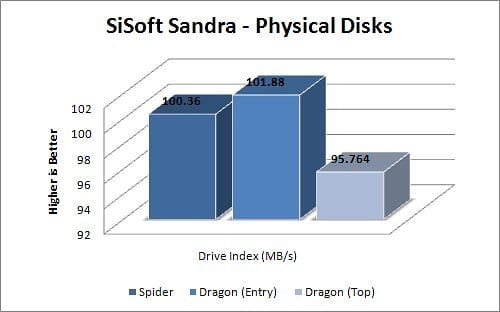
Hard drive testing was fairly straight forward, but it was important to verify whether there is or isn’t any performance difference in regards to I/O on either platform. With that in mind, it does come as a surprise that the lower speed rated processor of the bunch posted the highest MB/s speed rating. This may be due to extra operations running in the background on the test system, or a number of other factors. Really there should be any variance in speed since it’s the same hard drive. I guess we could either chalk this up to benchmark error or something running the background on our Vista x64 based test bed.
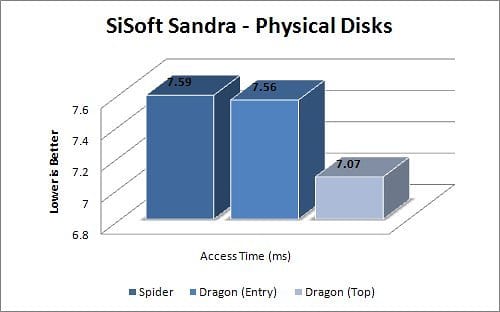
It’s still nice to know that access times weren’t drastically increased either way. We even managed to pull a near 7ms access time on the top-end Dragon platform.
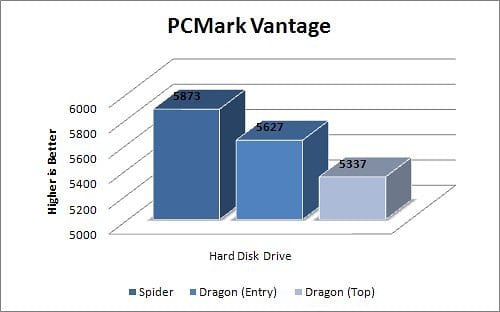
We decided once again to use PCMark Vantage to button everything up as see how each platform performs in the PCMark HDD test. These tests punish the hard drive to make sure it’s working and within spec. Here we see a drop in performance as we move up the specification ladder.
Once again there’s no reason for this other then system activity at the time the benchmark was running. Either way, the older system is the best one for hard drive performance.
Gaming Glory in 1337 Words or Less
Finally we turn to 3D performance in the hopes of showing how much or little of a performance boost you are getting moving from one platform to another. For a baseline test, we decided to do a couple run throughs of 3DMark Vantage.
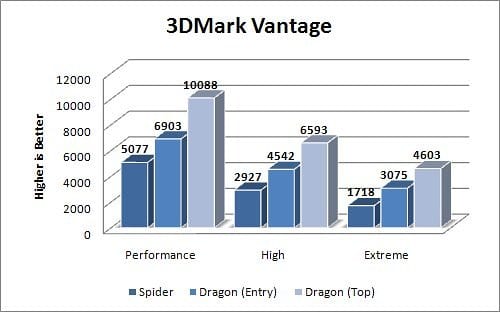
Here is where you can start to see the performance of the video cards start to take over. As we moved to each system, the results scaled with the power of video card being used. Though the processor did having something to do with, it seems to be the video card show from here on out.